

How to Write a Vision Statement for Your Company
Every legendary business — from garage-born startups to giant global conglomerates — begins with one brilliant spark of imagination. But as a company grows, that initial spark needs to be harnessed and clearly displayed so that it can light the way for others. It’s here that knowing how to write a vision statement for your company comes into play.
A vision statement isn’t just a catchy phrase for your “About Us” page; it is your organization’s North Star, right in tandem with your company mission statement. It defines where you are going, what you hope to achieve, and what the world will look like once you’ve actually succeeded as well.
In this guide, we’ll break down exactly how to write a vision statement that inspires your team, attracts the right talent, and keeps your business focused on its long-term impact in the world.
What is a Company Vision Statement?
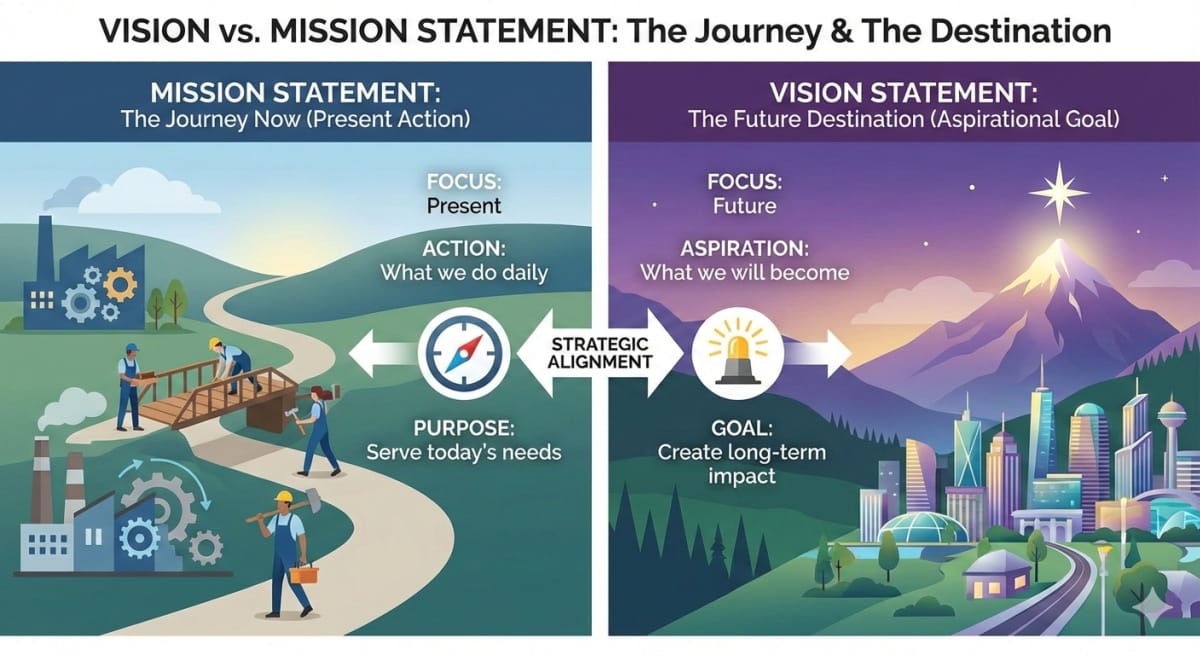
Before you put pen to paper, it’s important to distinguish between a vision statement and a mission statement. While it’s probably true that they are two sides of the same coin, each one serves its own distinct purpose.
• Mission Statement: Focuses on the now. It describes what you do, who you serve, and how you do it every day.
• Vision Statement: Focuses on the future. It is an aspirational blueprint of what the organization seeks to become in the next five, ten, or twenty years.
Think of the mission as the “boots on the ground” and the vision as the “view from the mountain top.”
Why Your Vision Statement Matters
Without a clear vision, a company risks “drift.” Drift occurs when daily tasks and short-term fires consume all your energy, leaving no room for strategic growth. Those issues are both easier to deal with, and less likely to steer you off course, if you have a strong company vision statement in place. Your vision should provide:
1. Strategic Alignment: It helps leaders make difficult decisions by asking, “Does this move us closer to our vision?”
2. Employee Inspiration: People want to work for more than just a paycheck; they want to be part of a meaningful journey.
3. Brand Identity: It tells customers what you stand for and the kind of future you are trying to build.
How to Write a Vision Statement in 5 Steps
Writing a vision statement requires a mix of grounded reality and blue-sky thinking. Follow these five simple steps to draft one that resonates.
1. Gather Your “Dream Team”
While a founder often has the initial spark, a vision statement is more powerful when it reflects the collective ambition of the leadership team. Organize a brainstorming session where stakeholders can speak freely about the company’s ultimate potential.
2. Focus on the “Outcome,” Not the “Output”
Don’t focus on the products you sell. Instead, focus on the impact those products have on the world.
• Output: We want to sell the best running shoes.
• Outcome: We want to bring inspiration and innovation to every athlete in the world.
3. Project 5 to 10 Years into the Future
Think about the future… imagine that it’s ten years from today. Your company has been wildly successful and reached many if not all of its initial goals.
What does the world look like? What have you changed? Your vision should be ambitious enough that it feels slightly out of reach today, but also grounded enough to be possible.
4. Keep it Concise and Memorable
A vision statement that no one remembers is also a vision statement that no one follows. Obviously, that is not what you want. So aim for one sentence, two at most. Use “power verbs” and avoid corporate jargon like “leverage,” “synergy,” or “best-in-class.”
Make it real, keep it clear and concise.
5. Refine and Iterate
Your first draft will likely be too long, and that’s completely fine. Let that first draft flow and just put pen to paper.
Once your team feels that everything you could possibly include is in that draft, step away from it for at least a day; then, come back to it as a team and spend the extra time on it to cut the fluff. It may take three or four iterations before everyone is happy, and that’s fine. Put in the time, it will be worth it in the end.
Examples of World-Class Vision Statements
To help you find your voice, look at how some of the world’s most successful brands define their future:
LinkedIn Vision Statement
To create economic opportunities for every member of the global workforce.
Disney Vision Statement
To entertain, inform and inspire people around the globe through the power of unparalleled storytelling.
IKEA Vision Statement
To create a better everyday life for many people.
Common Pitfalls to Avoid
Even with the best intentions, it’s easy to write a vision statement that falls flat. Watch out for these three traps:
• Being Too Vague: If your vision statement could apply to any company in any industry (e.g., “To be the best at what we do”), it’s not specific enough to guide your team.
• Setting Unrealistic Timelines: While a vision is aspirational, it shouldn’t feel like science fiction. It must be rooted in your company’s core DNA.
• Ignoring It After It’s Written: A vision statement belongs on your walls, in your town hall meetings, and in your performance reviews. It does not belong buried in a digital folder somewhere on your company’s intranet.
Bringing Your Vision to Life
Once you learn how to write a vision statement and you finalize your text, the real work begins. Your vision should be the filter through which every new project, hire, and marketing campaign passes before being put into practice. When your team understands the “why” behind their work, they become more than just employees — they become pioneers helping to build your company’s future.
BizRealtyLab Pro Tip: For a deeper dive on crafting a company vision statement, inclusing several more examples as food for thought, check out this article from Grammarly.